Deploying MCP servers in production: the 2026 attack surface and the defense stack
More than 40 CVEs in the first four months of 2026, a protocol-design command injection in Anthropic's reference SDK that Anthropic has declined to patch, and a defensive-tooling market that mostly shipped its first product six months ago. A playbook for teams shipping MCP servers in front of agents that touch production state.
TL;DR. Between January and April 2026, researchers disclosed more than 40 CVEs against Model Context Protocol implementations across Python, TypeScript, Java, and Rust SDKs, including a design-level STDIO command injection in Anthropic’s reference SDK that affects more than 7,000 publicly accessible servers and packages totaling 150 million+ downloads. Anthropic has called the behavior “expected” and has not changed the protocol. MCP went from obscure to the default agent-integration layer in roughly eighteen months; defense lagged. This post is the deployment playbook: the seven attack classes worth understanding, the six defense layers that actually hold together, a deliberately compact tool inventory, and a seven-question pre-deployment checklist. The last section maps Highflame’s MCP Gateway and ZeroID stack onto the six defense layers, layer by layer.
The threat model in one paragraph
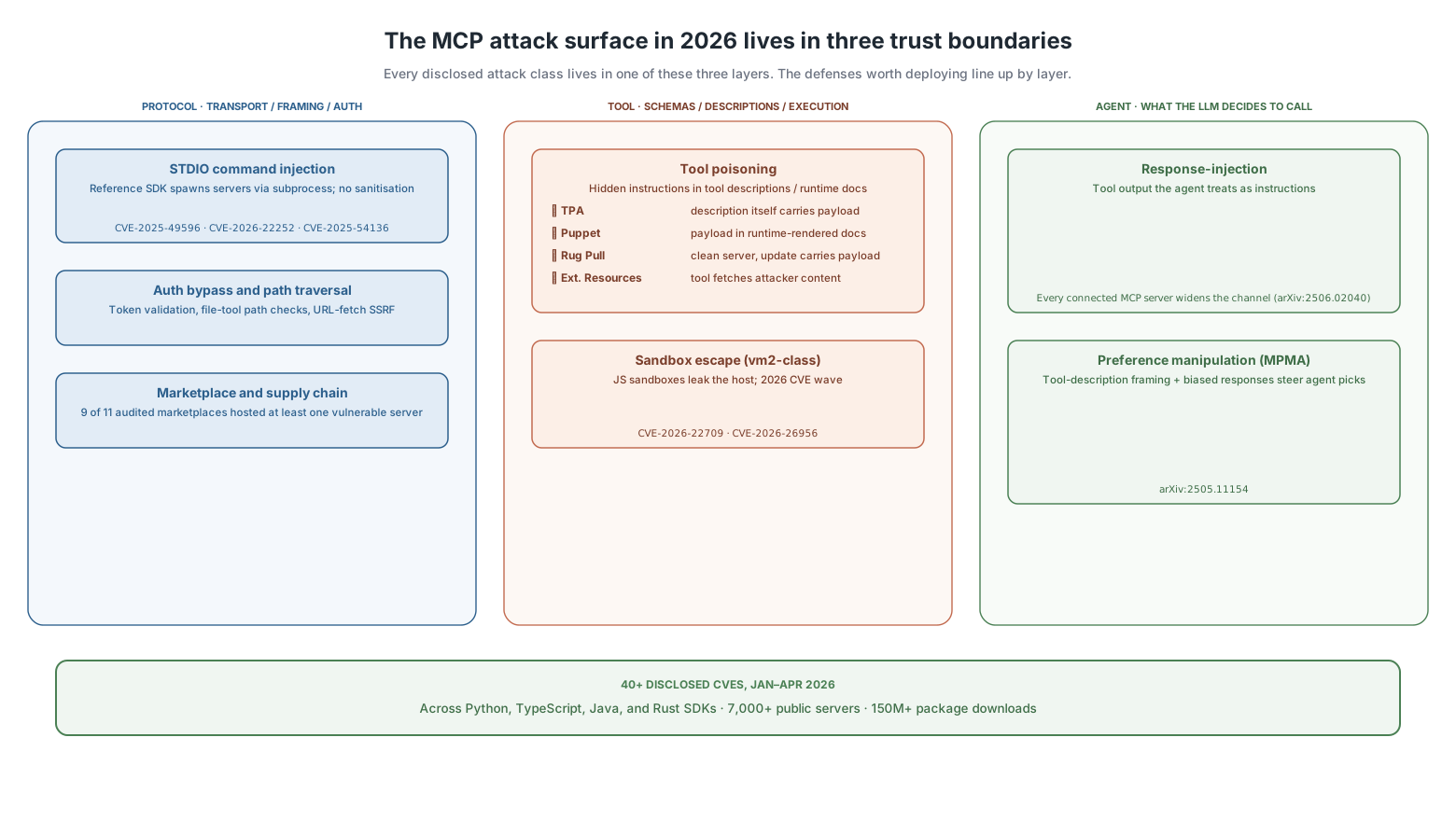
MCP defines three trust boundaries. The protocol layer carries transport, framing, and auth. The tool layer carries the schemas, descriptions, and executable surface that each MCP server exposes. The agent layer is what the LLM decides to call, with what arguments, in what sequence. Every disclosed attack class lives in one of these three layers, and the defenses worth deploying line up by layer.
Seven attack classes worth understanding
1. STDIO command injection (protocol layer). Anthropic’s MCP SDK uses STDIO as primary transport and spawns servers via subprocess without sanitising the spawned command string. OX Security disclosed this as an ecosystem-wide class in April 2026, with downstream CVEs across mainstream projects: CVE-2025-49596 (MCP Inspector), CVE-2026-22252 (LibreChat), CVE-2026-22688 (WeKnora), CVE-2025-54994 (@akoskm/create-mcp-server-stdio), CVE-2025-54136 (Cursor) [1]. Anthropic declined to modify the protocol, calling the behavior “expected.” Practical mitigation: avoid STDIO transport in production where you can. If you cannot, audit every spawn site, review server configuration as code, and pin the SDK version. At least one of these CVEs landed in a point release.
2. Tool poisoning and its variants (tool layer). Malicious instructions hidden in a tool’s natural-language description; the agent reads the description and follows the injection. Four documented variants [2]:
- Tool Poisoning Attack (TPA) — the description itself carries the payload.
- Puppet Attack — payload lives in documentation rendered at runtime.
- Rug Pull — the server ships clean, an update carries the payload.
- Malicious External Resources — a tool fetches and surfaces attacker-controlled content.
Rug Pull is the meanest of the four because it survives initial review. Implication: pin every MCP server version, gate updates on a re-review, and static-scan tool descriptions on every config change.
3. Response-injection (agent layer). A tool returns content; the agent treats parts of the response as new instructions. This is the same injection class that has broken every other LLM tool-use surface, and MCP inherits it directly. Because MCP standardises the description / argument / response surface that any tool exposes to any agent, the injection channel widens: every additional MCP server the agent connects to is another potential prompt source treated as semi-trusted by default [3].
4. Sandbox escape via JS-side sandbox libraries (tool layer). Several agent frameworks executed tool code inside vm2 and similar JavaScript-side sandboxes. A wave of 2026 CVEs (CVE-2026-22709, CVE-2026-26956, others) demonstrated that those sandboxes leak the host. Any MCP server that runs untrusted code from tool arguments inside a JS sandbox is one CVE away from host RCE. Language-level sandboxes are no longer a defense; use OS-level isolation (containers, gVisor, Firecracker) or remove the execution surface entirely.
5. Preference manipulation (agent layer). A 2026 paper [4] demonstrated that a malicious MCP server can shape the agent’s tool selection, preferring itself over competitors with otherwise-identical advertised behavior, through tool-description framing and small, consistent positive bias in tool responses. The defense lives at the agent layer: multi-server scoring with provenance signals, not vendor-supplied descriptions alone.
6. Marketplace and supply chain. Of eleven public MCP marketplaces audited in the first months of 2026, nine were found to host at least one vulnerable server [5]. Install-by-name is not safe. Treat MCP-server install like adding a Docker image from an unknown registry: pin by hash, mirror to an internal registry, scan before promote.
7. Auth bypass and path traversal. The residual roughly 57% of disclosed CVEs that are not shell injection: token validation bypasses, path traversal in file-tool implementations, SSRF in URL-fetching tools [5]. The fixes are textbook; that they shipped in mainstream MCP servers in 2026 tells you the bar in the ecosystem is low.
The six-layer defense stack
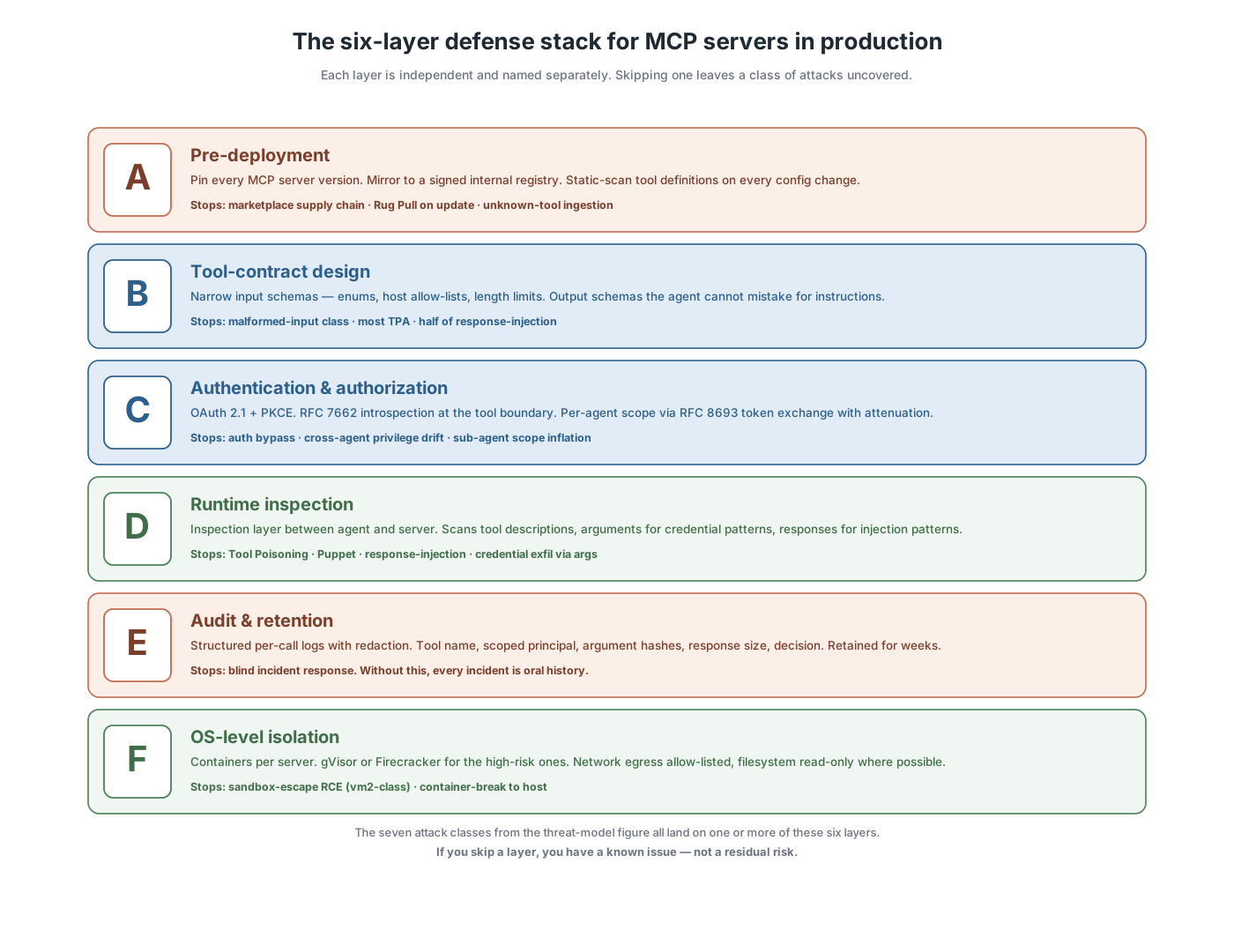
A — Pre-deployment. Version-pin every MCP server in source control. Block CI on unpinned servers. Run a static scanner against tool definitions on every config change. Mirror servers to an internal registry signed by hash; the registry becomes the production source of truth, not the public marketplace.
B — Tool-contract design. Input schemas are the cheapest line of defense. Use enums where the parameter is bounded, allow-listed hosts where a URL appears, explicit length and type limits everywhere. The schema rejects malformed input before any agent code runs. Output schemas matter too: structure the response so an agent cannot easily mistake an attacker payload for a normal field.
C — Authentication and authorization. The June 18 2025 MCP spec revision formally classified MCP servers as OAuth 2.1 resource servers and required clients to use Resource Indicators (RFC 8707) and Protected Resource Metadata (RFC 9728); OAuth 2.1 with PKCE (S256) is mandatory for clients [6]. Validate tokens via RFC 7662 introspection at the tool boundary. For multi-agent systems, scope tokens per agent; never let a sub-agent inherit a parent’s full surface. The OAuth 2.1 + RFC 8693 token-exchange pattern, with scope attenuation enforced on every delegation hop, is the right shape.
D — Runtime inspection. Between the agent and the MCP server, run an inspection layer that scans:
- Tool descriptions on every session (catch TPA, Puppet, and Rug Pull).
- Tool arguments for credential-shaped patterns (block agents leaking secrets back to the server).
- Tool responses for prompt-injection patterns and out-of-schema content.
This layer is where most of the defensive-tooling market lives (gateway-style products). It is not optional.
E — Audit and retention. Structured per-call logs with redaction discipline: tool name, scoped principal, argument hashes (not raw arguments), response size, decision (allow / forbid / flag). Retention long enough to investigate an incident measured in weeks, not hours. Without this layer, every incident becomes an oral history.
F — OS-level isolation. If a tool executes anything, do not trust language-level sandboxes after the 2026 vm2 wave. Containers per server. gVisor or Firecracker for the high-risk ones. Network egress allow-listed; filesystem read-only where possible.
Tool inventory (honest one-liners)
For most companies the right mix is one gateway (Layer D), one scanner (Layer A), and a deliberate identity choice (Layer C). Useful as of mid-2026:
- OWASP Gen AI Security MCP guide — the right starting reading: free, vendor-neutral, written by practitioners [7].
- MCP Inspector (Anthropic) — official protocol inspector; useful for development. It has had its own CVE (
CVE-2025-49596); do not expose it to production traffic. - mcp-scan (open source) — static scanner over tool definitions; integrates into CI. Cheap and worth the slot.
- TrueFoundry MCP Gateway, MintMCP, Lunar MCPX, Lasso Security, Composio, Bifrost — commercial gateways, broadly similar shape (inspection + audit + auth). MintMCP advertises SOC 2 Type II, which matters for regulated buyers [8].
- IBM ContextForge — enterprise-marketed; relevant if your organisation already runs IBM identity infrastructure.
There is no consensus winner. The gateway category is roughly two years old. Buy small, expect to rip and replace inside eighteen months.
The seven-question pre-deployment checklist
Before any MCP server is exposed to an agent that touches production state:
- Is the server version pinned, mirrored, and signed?
- Are tool descriptions static-scanned on every config change?
- Is every tool input schema as narrow as the action allows (enums, host allow-lists, length limits)?
- Is the auth path OAuth 2.1 with PKCE, validated at the tool boundary via RFC 7662 introspection, with scope agent-specific?
- Is there a runtime inspection layer between agent and server, scanning descriptions, arguments, and responses?
- Is execution OS-isolated (container minimum; Firecracker or gVisor for high-risk)?
- Are per-call structured logs retained long enough to investigate an incident weeks later?
If any answer is “no”, you have a known issue, not a residual risk.
Where Highflame fits (the parts I work on)
I work on the agent control plane at Highflame. The relevant product surface here is the MCP Gateway (Firehog routing + Shield detection + Ramparts scanning) sitting between agents and the MCP servers they call, with ZeroID in front as the identity layer. The mapping onto the defense layers above, with coverage stated honestly:
-
Layer D (runtime inspection) — MCP Gateway. Every tool call routes through Firehog and into Shield, which scans tool descriptions for TPA / Puppet / Rug Pull patterns, arguments for credential and PII patterns, and responses for injection patterns. The architectural distinction is the policy floor: detection signals project into Cedar policy context, and the allow/deny decision is made by deterministic policy evaluation, not by the same model the agent is using.
forbidoverridespermit. A model that lies to itself cannot lie around a Cedar rule, because the model is never the evaluator. -
Layer C (authentication and authorization) — ZeroID. One cryptographic identity per agent (OAuth 2.1 + RFC 8693 token exchange + WIMSE), with scope attenuation enforced at the token-exchange endpoint. A monitor agent granted
logs:readcannot mint a downstream token that carriesweights:write. The math says no. Cascade revocation contains the blast radius if any identity drifts, and the MCP Gateway honours those scopes per tool call. -
Layer A (pre-deployment) — Ramparts. Open-source MCP scanner targeted at the IDE-side and shipped as the static-scan component of the MCP Gateway. Drops into your CI step as the Layer A scanner. Useful well beyond Highflame deployments.
-
What it does not cover. Layer B is your job; no platform redesigns your tool contracts. Layer E (audit) is present in the Gateway and exposes structured per-call logs, but expects integration with your SIEM rather than replacing it. Layer F (OS-level isolation) is your container platform, not an MCP-Gateway surface.
Status and further reading
The bar for shipping MCP in 2026 is higher than the marketing suggests. The CVE count tells you the ecosystem is still learning; the tooling market is fragmented and immature. Build for the threat model, not for any vendor’s roadmap. The pre-deployment checklist above does most of the work in practice: if every question gets a documented “yes” before each MCP server reaches production, you are doing better than most of the ecosystem.
Sources, all worth a read on their own:
- [1] Anthropic MCP Design Vulnerability Enables RCE, Threatening AI Supply Chain — The Hacker News, April 2026. Companion: the OX Security advisory is the upstream technical write-up.
- [2] Beyond the Protocol: Unveiling Attack Vectors in the Model Context Protocol (MCP) Ecosystem — arXiv:2506.02040. Formalises the four tool-poisoning categories used above.
- [3] Same as [2]: the paper situates response-injection alongside the four tool-poisoning categories as the agent-layer attack surface MCP standardises.
- [4] MPMA: Preference Manipulation Attack Against Model Context Protocol — arXiv:2505.11154.
- [5] MCP Security Vulnerabilities in 2026: 40+ CVEs and Counting — DEV Community. Source of the “40+ CVEs in Jan–Apr 2026”, “9 of 11 marketplaces”, and “~43% shell injection” figures.
- [6] Authorization and Security Best Practices — Model Context Protocol, June 18 2025 spec revision.
- [7] OWASP Gen AI Security Project, A Practical Guide for Secure MCP Server Development.
- [8] Best MCP Security Tools in 2026 — TrueFoundry.
- The State of MCP Security 2026 — PipeLab; source of the “obscure to default in less than 18 months” framing.